
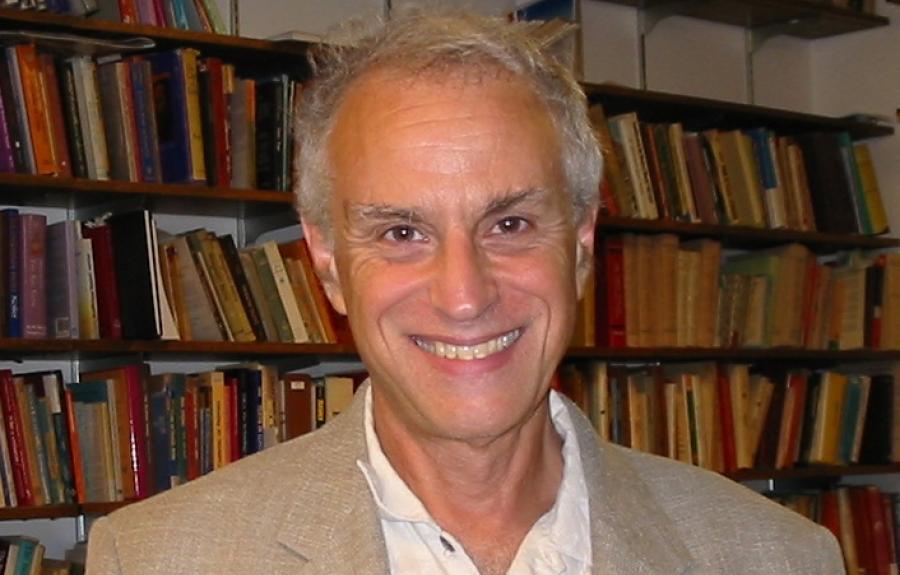
Daniel Gold, Professor Emeritus of Asian Studies at Cornell University, brought remarkable intellectual and personal strengths to academic work. His many years of contributions in South Asia studies and religious studies encompassed a multifaceted career of academic writing, documentary film making, and translation. Interwoven with such creative commitments were Gold’s teaching and mentoring at undergraduate and graduate levels, and substantial contributions in administrative leadership. For most of his adulthood, Daniel Gold’s spirit of inquiry drew him back and forth between India (especially Madhya Pradesh and Rajasthan) and the United States, often in companionship and collaboration with his wife and academic colleague, anthropologist Ann Grodzins Gold (Professor Emeritus, Syracuse University). Their children, Jonah and Eli, came to know India firsthand in the 1990s, accompanying their parents on two longish stays. Gold remained a devoted student of the late Malik Sahib of Gwalior and frequently spent time at the ashram he founded, Adhyatma Niketan.
Born in Newark, NJ (USA) and raised in Los Angeles, CA (USA), a love of languages led Daniel Gold to undergraduate studies at the University of California-Berkeley where he focused on Slavic Languages & Latin. Subsequently, Gold entered the Peace Corps to serve training teachers of English in India, before beginning doctoral studies in the History of Religions at the University of Chicago Divinity School. The program demanded that its students find ways of navigating the demands of comparative and tradition-specific scholarship, and modeled a variety of approaches to this end such as the contrasting intellectual styles of Joseph Kitagawa and Mircea Eliade. As an emerging scholar of South Asian religions with a particular interest in the way of the sants – Indic guru-centered traditions of religious practice established in the fifteenth century – Gold worked closely with Frank Reynolds and Wendy Doniger, as well as other scholars in the humanities at the University of Chicago. Jonathan Z. Smith’s gift for developing comparatively stimulating proposals from compactly analyzed cases left its mark on Gold. His abiding fascination with languages and translation was nurtured by the Department of South Asian Languages and Civilizations, where he worked with Norman Zide, C.M. Naim, Edwin Gerow, and Kali C. Bahl. Bahl’s training laid the foundation for Gold’s lifelong engagement with historical and contemporary forms of Hindi language
After receiving his Ph.D. in 1982 Daniel Gold was appointed to visiting professorships at Vassar College and Oberlin College, followed by a Mellon Fellowship at Stanford University (1985-6). In 1986, Gold joined Cornell University as Assistant Professor. Rising rapidly through the faculty ranks, he was appointed Professor of South Asian Religions in 1997. Daniel Gold and Ann Grodzins Gold, whose early relationship was nurtured by conversations and collaborations during graduate studies at the University of Chicago, were an early and enduring example of dual-career flourishing, a heartening example in the eyes of their junior colleagues and students.
At Cornell University, and at the nearby Syracuse University (a long-time collaborating partner in South Asia studies), Daniel Gold was held in esteem for his ongoing administrative contributions which helped secure and assure funding streams in support of South Asian language teaching, as well as multi-media event programming. Gold was twice appointed as Director of the Cornell University South Asia Program (1991-1994 and 2008-2013). In that role, he helped Cornell to secure two prestigious and financially substantial U.S. National Resource Center (NRC) / Foreign Language and Area Studies (FLAS) awards in support of Cornell’s South Asian language curriculum, as well as outreach to expand South Asia-related education in New York State primary and secondary schools, plus programming and fellowships for faculty and graduate students. As Director of the South Asia Program, Daniel Gold worked closely with his counterparts at the Syracuse University South Asia Center. Gold’s second term as South Asia Program Director coincided with the 2008 financial crisis that posed substantial challenges for the financing of U.S. higher education. Daniel Gold played a critical role in helping Cornell University’s South Asia Program survive a period of austerity.
From the early 2000s, Gold was the senior South Asianist in the Department of Asian Studies at Cornell University. In that capacity, he helped to lead the department’s expansion to include more teaching and research related to South and Southeast Asia. Subsequently Gold was appointed as Chair of the Department of Asian Studies, serving a three-year term (2017 to 2020). This occurred at a time of generational transition within the department. Gold strongly supported colleagues’ collaborative effort to articulate afresh the department’s intellectual and pedagogical mission. In the Department of Asian Studies and elsewhere on Cornell University’s campus, Dan Gold is remembered with warmth and respect. After the establishment of Cornell University’s Asian Religions doctoral field in 2000 (eventually succeeded and encompassed by the current Asian Literature, Religion and Culture Ph.D. field), Daniel Gold’s reputation drew a steady stream of thoughtful and capable graduate students to Cornell University. Here under Daniel Gold’s supervision, they pursued doctoral studies on topics related to the religious practices and institutional forms of late-colonial, modern, and contemporary India, as well as Hindi and Sanskrit textual cultures.
In conversation, Daniel Gold was often gently spoken, and did not rush to fill silences with unnecessary words. This peaceable manner accompanied a powerfully creative and incisive mind, tilted by Gold in a number of directions in the course of a long and distinguished career.
As a scholar of sant traditions, Daniel Gold wrote both for South Asianists and a wider group of religious studies scholars. The Lord as Guru: Hindu Sants in North Indian Tradition (Oxford University Press, 1987) is a remarkable study that explores the possible Indic (including Islamic) roots of the sant traditions while also charting historical changes and adaptive processes that occurred through early modern into modern times. One of the preoccupations of The Lord as Guru (which received a book award from the American Council of Learned Societies in 1989) is to explore how it is, and has been, conceptually and aesthetically possible for devotees of the sant teachers to see and feel the divine through such teachers. Gold contrasts the gurus with other “vital conduits through which the divine reveals itself” in Hindu religious traditions (the Hindu deity and the Vedic heritage) (7). The question is acute, in both senses of the word, since sant traditions are absent the Vedic (in the broader sense) Sanskritic scriptural orientation that often trains a devotee in the religious work of devout perception. Gold shows how “tradition” and “heritage” function(ed) for sants, and suggests that more than one form of Indic (including Sufi) teaching and practice prefigured the sant as “holy man.” Gold’s curiosity about the sants’ own vernacular (and originally oral) textual traditions led to his subsequent studies of the sants’ poetic/bardic works.
While The Lord as Guru was written for South Asianists with an Indological bent and a taste for historical-textual detail, Gold explicitly addressed a wider audience of historians of religion in Comprehending the Guru: Toward a Grammar of Religious Perception (Scholars Press and The American Academy of Religion, 1988). Here Gold’s identification of the “immanent foci” (holy man, incarnate god/founder, and concept of tradition) developed in The Lord as Guru, are set out as elements to be used in the analysis of patterns. In Gold’s words, “Simple categories themselves, their interest lies in the relationships that they can reveal among factors of religious life and institutions, and what they suggest about the propensities of the human imagination” (1988, 9). Here, as elsewhere in his work, Gold’s reading is humane, kindly critical, and ultimately hopeful, indirectly addressing disciplinary crises that had begun to emerge in his own field of the history of religions.
The entities we posit to describe these human situations appear believable just to the extent that we can build on them, using them to hold together a connected body of religio-historical knowledge. None of what we tentatively construct is eternal, and much will not last long at all. But this early stage in the growth of our collective knowledge seems to call for tolerance as well as experimentation. If we cannot examine the reality of others’ religio-historical constructs by using them ourselves, let us at least take the trouble to see their significance in the world in which they are described. Unbridled critical iconoclasm is likely to leave us with little indeed: no body of relative knowledge and no Formless Lord either (130).
For scholars of religion, seeing the significance is one thing, yet communicating that significance to others is another. The latter poses many challenges of representation of which Daniel Gold was well aware. His third book, Aesthetics and Analysis in Writing on Religion (University of California Press, 2003), was one way of continuing to work out answers to these problems, investigating and analyzing instances of “interpretive writing” in religious studies. Offering a distinctive analytical perspective on twentieth-century religious studies scholarship and one path forward for a discipline still in crisis, Aesthetics and Analysis was perhaps also undertaken in the spirit of Gold’s own refinement of his writerly craft. In Gold’s words, writing about the historical writing on religion: “Writers make reference to materials that are eminently outside the reader and felt to be such: historically attested and often very other. But interpreting these materials imaginatively can make distant moral worlds reverberate within the reader as well. The writer’s art here comes through making his or her own personal resonances vibrate at once with that distant world and the present contemporary one” (2003, 236).
For several decades, in articles and book chapters, Gold wrote about modern and contemporary religious practices and communities in India, conducting research during repeated stays in Rajasthan and Madhya Pradesh, supported by a Fulbright-Hays Fellowship and several from the American Institute of Indian Studies. These visits of research and sociability with longtime friends and collaborators, as well as new interlocutors, generated a corpus of specific case studies while also building Daniel Gold’s macro-scaled sense of how northern Indian Hindu spaces, practices, and collectivities were taking shape during the years of economic “liberalization” and rapid social and environmental change. Gold’s final monograph, Provincial Hinduism: Religion and Community in Gwalior City (Oxford University Press, 2015), distills this socio-cultural perspective as well as his flair for humane and lucid ethnographic writing in a rich study of one of the “ordinary mid-sized cities” of the “Hindi-speaking areas” (1). Arguably, Daniel Gold’s ability to create vivid word-pictures in Provincial Hinduism had been shaped also by his study of documentary film-making, which resulted in two works released by the Cornell University South Asia Program in the mid-2000s.
Nearing retirement, Gold was keen to return to reading and translating poetic works produced within the early modern sant traditions, and investigating the puzzle of their early history. These projects brought Daniel Gold back to his earliest research with fresh eyes. The field had changed in useful ways. Thus, Gold engaged with newer work on histories of siddha and nath traditions, as well as scholarship on the historical interrelationships of Hindu and Islamic traditions within a shared regional culture that stretched from what are now Gujarat and Rajasthan to West Asia. Gold, who had earlier theorized about collaborative scholarship on religion in Aesthetics and Analysis, entered a robust research undertaking with Professor Dr. Monika Horstmann (Boehm-Tettelbach). This resulted in the recently published article co-authored with Horstmann: “Prithīnāth: Nāth Siddha Yoga and Intertwined Traditions in the Sixteenth Century” (Zeitschrift für Indologie und Südasienstudien, Band 42/2025). This massive study develops historical and theological analyses – as well as original translations – from an unpublished corpus of 17th-century literature. Gold’s longtime interest in translating early modern devotional and didactic sant poems manifested also in his contribution as editorial translator of the poetic works anthologized within In the Shrine of the Heart: Sants of Rajasthan from the Sixteenth and Seventeenth Centuries (Heidelberg Asian Studies Publishing, 2023) authored by Horstmann and Professor Dalpat S. Rajpurohit. In this work, dedicated by the authors to Daniel Gold, we find the following:
My mind is weary of speaking. It’s absorbed itself into consciousness. (refrain)
While thinking and reason drive all that is spoken, true wisdom is beyond the senses, has no limits, and can’t be approached.
How can a drop try to measure the ocean? Can that which can’t be spoken ever be expressed?
Like the firebird soaring into the beyond, Rām fills all.
Brother, this is how I’m thinking now:
Dādū cannot speak of the unspeakable.
(2023, 113)
Anne M. Blackburn, Ithaca, NY, USA